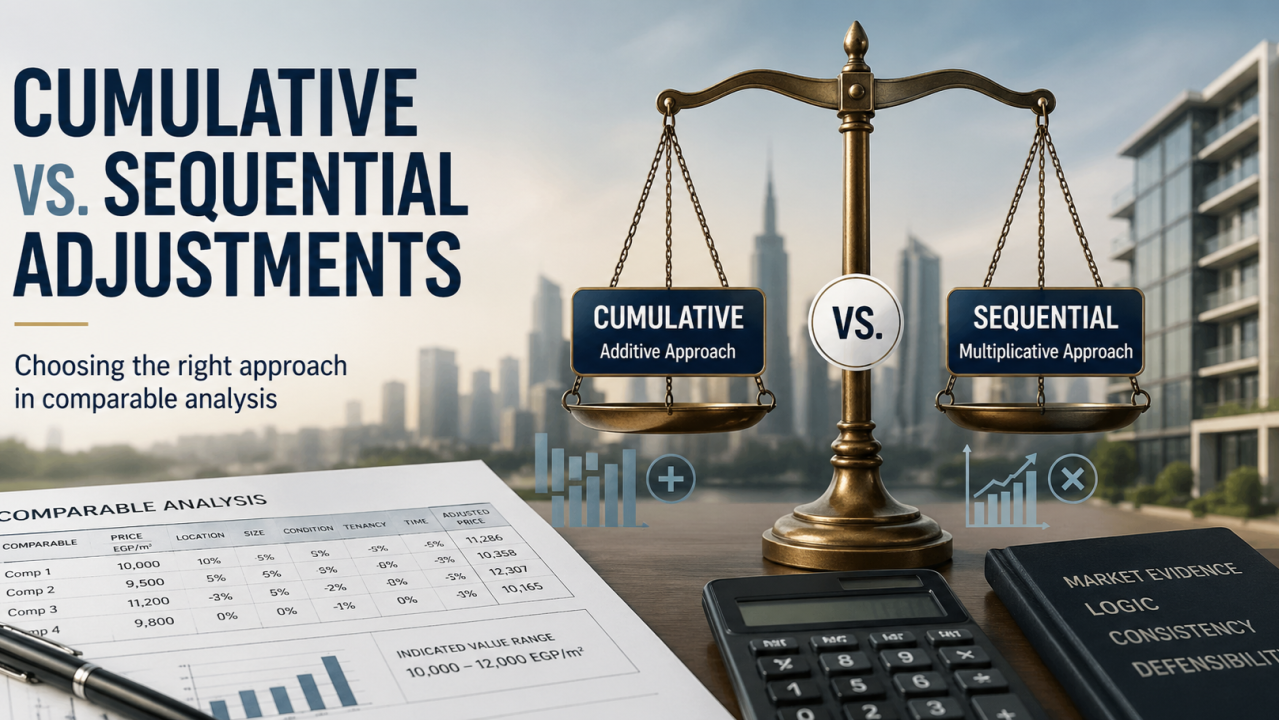

Cumulative vs. Sequential Adjustments in Comparable Analysis: A technical note for valuation practitioners
April 28, 2026

1. Why this matters
In comparable analysis, the integrity of your conclusion is only as strong as the adjustment methodology. While most practitioners focus heavily on what adjustments to apply (location, size, condition, tenure, etc.), far fewer scrutinize how those adjustments are applied mathematically.
The distinction between
cumulative (additive) and sequential (multiplicative/compounded)
adjustments is not academic—it can materially alter your indicated value, particularly in volatile or imperfect markets.
2. Definitions
Cumulative Adjustments (Additive Approach)
All adjustments are applied independently to the base comparable price and then summed:
Adjusted Price = P × (1 + a₁ + a₂ + a₃ + … + aₙ)
- Each adjustment references the original base price
- Assumes independence between variables
- Simpler to implement, but structurally linear
Sequential Adjustments (Multiplicative / Compounded Approach)
Adjustments are applied one after the other, compounding on the adjusted price:
Adjusted Price = P × (1 + a₁) × (1 + a₂) × (1 + a₃) × … × (1 + aₙ)
- Each adjustment builds on the previous one
- Captures interaction between variables
- More aligned with actual market pricing behavior
3. Numerical Illustration
Assume:
- Comparable price = 10,000 EGP/m²
- Adjustments:
Cumulative (Additive) 10,000 × (1 + 0.10 − 0.05 + 0.08) = 11,300
Sequential (Compounded) 10,000 × 1.10 × 0.95 × 1.08 = 11,286
At small adjustment levels, the difference is marginal. However, with larger or multiple adjustments, divergence becomes material and systematic.
4. Conceptual Implications
Cumulative (Additive):
- Imposes a linear pricing structure
- Risks are overstated when multiple upward adjustments exist
- Ignores interaction (e.g., premium location amplifying condition effect)
Sequential (Multiplicative):
- Reflects real buyer pricing logic (holistic, not segmented)
- Captures compounding and interaction effects
- Consistent with broader financial modeling principles
5. Alignment with Standards
Neither the International Valuation Standards Council (IVS) nor the Royal Institution of Chartered Surveyors (RICS) prescribes a strict mathematical method. However, both emphasize:
- Logical consistency
- Market alignment
- Avoidance of systematic bias
Sequential adjustments are typically more defensible in an audit or dispute because they better reflect market participants' behavior.
6. Where Valuers Go Wrong (Common Failure Modes)
This is where most valuation risk actually sits—not in theory, but in execution:
1. Mixing methodologies, unintentionally applying some adjustments cumulatively and others sequentially without disclosure.
2. Double-counting effects Example: adjusting for location and then separately adjusting for demand, when demand is already embedded in location.
3. Oversized adjustments are applied linearly. Applying ±20–40% adjustments cumulatively leads to distortion.
4. Wrong order in sequential models. In a sequential model, order matters. Poor sequencing can bias results.
5. Lack of anchoring to market evidence. Adjustments become theoretical rather than empirically derived.
7. How to Avoid the Risks (Practical Controls)
This is the critical addition most practitioners overlook—methodology governance.
1. Define your adjustment framework upfront
- Explicitly state: “Adjustments are applied sequentially (or cumulatively)”
- Maintain consistency across all comps
2. Cap and sanity-check adjustment magnitudes
- Flag any single adjustment > ±15–20%
- If exceeded → reassess the comparability itself (it may not be a valid comp)
3. Use a structured adjustment hierarchy (for sequential models)
Apply adjustments in a consistent, logical order:
- Time (market movement)
- Location
- Physical characteristics (size, specs)
- Condition/age
- Income/tenancy factors
This reduces sequencing bias.
4. Perform sensitivity analysis
- Run both cumulative and sequential models
- Quantify the variance
- If variance > 3–5% → investigate drivers
This is particularly useful in audit and IFRS contexts.
5. Avoid double-counting through variable mapping
Create a simple matrix:
Factor Captured in Adjustment Overlap
Risk Location Yes Demand Condition Yes Obsolescence Tenant Quality Yes Yield
This forces discipline and prevents overlap.
6. Anchor adjustments to observable data
- Transactional evidence
- Regression analysis (where data allows)
- Broker validation
Avoid purely judgmental percentages unless clearly disclosed.
7. Reconcile back to market reality
After adjustments:
- Does the adjusted comp sit within a realistic market range?
- Would a real buyer transact at this level?
If not → your math is correct, but your valuation is wrong.
8. When to Use What
Scenario Preferred Approach Simple, low adjustment comps Cumulative acceptable Multiple / large adjustments Sequential preferred Audit / litigation / IFRS Sequential strongly preferred Volatile markets (e.g., FX shocks)Sequential
9. Key Takeaway
The real risk is not choosing the “wrong” method—it is:
Applying a method inconsistently, without control, and without reference to market behavior
10. Final Thought
Valuation debates often focus on:
- Cap rates
- Comparable selection
- Discount rates
But in many challenged valuations, the root issue is simpler:
The mathematics of adjustment was not robust.
A well-supported comp with weak adjustment methodology is still a weak valuation.
More Blogs: